Quick answer
Rank manufacturers by evidence, not follower count. The strongest signals are relevant production capability, clear commercial terms, a controlled sample process, measurable bulk standards and a written remedy path.
The question behind this guide
How do I tell a suitable factory from a convincing profile?
Recent founder discussions ask how to find manufacturers and avoid a mismatch between expectations, samples and bulk goods. The recurring concern is not simply whether a business exists, but whether it fits the proposed product and order.
Read the community discussionThe eight signals are an editorial priority list, not a ranking of named factories. There is no validated scoring model or pass mark; an unresolved critical issue cannot be averaged away.
Key takeaways
- A polished social profile does not prove production capability.
- Relevant product experience matters more than a broad catalog.
- The approved sample needs matching documents and tolerances.
- Start with a controlled order and preserve inspection rights.
The 8-signal ranking
| Rank | Signal | Evidence to request |
|---|---|---|
| 1 | Relevant product capability | Current similar products and machines |
| 2 | Transparent commercial scope | Itemized quote and payment milestones |
| 3 | Controlled sampling | Revision plan and approval record |
| 4 | Measurable bulk standard | Spec, tolerances and sealed sample |
| 5 | Material traceability | Fabric source, lot and test data |
| 6 | Live operational verification | Current video call or third-party audit |
| 7 | References and shipment history | Relevant buyer references where permitted |
| 8 | Remedy terms | Written defect and rework process |
A safe first-order sequence
- Shortlist against product and quantity fit.
- Hold a structured capability call.
- Confirm commercial terms in writing.
- Develop and revise the sample.
- Approve measurements, materials and artwork together.
- Use pre-production and inline checkpoints where risk requires them.
- Inspect bulk before final release or shipment.
Compliance is a separate workstream
Supplier vetting should include accurate fiber, care and origin information, but forum advice is not legal guidance. Use the official rules for the destination market and qualified advisers for product-specific decisions.
Separate legitimacy, suitability and execution
Legitimacy asks who you are contracting with. Suitability asks whether that business can deliver the specific garment at the proposed order size. Execution asks whether the order follows the approved specification. A credible company can still be the wrong fit for a complex small run.
Build a separate evidence note for each question. A registration document does not show the quality of a collar seam; a good sample does not establish the identity of the invoice recipient. Keeping those questions separate prevents one impressive detail from carrying more weight than it deserves.
Use an evidence register instead of a decorative score
A supplier should not pass because several easy questions compensate for an unresolved identity or specification issue. Mark critical items explicitly. Keep a date and a short reason for each status rather than presenting an arbitrary percentage as an audit result.
| Evidence status | Meaning | Next action |
|---|---|---|
| Claimed | A statement has been made but not supported | Request the relevant record |
| Received | A file, sample or video has been supplied | Check identity, scope and date |
| Checked for this order | The evidence matches the current requirement | Record who reviewed it and any limitations |
| Open | The issue is unresolved or information conflicts | Resolve before the affected commitment |
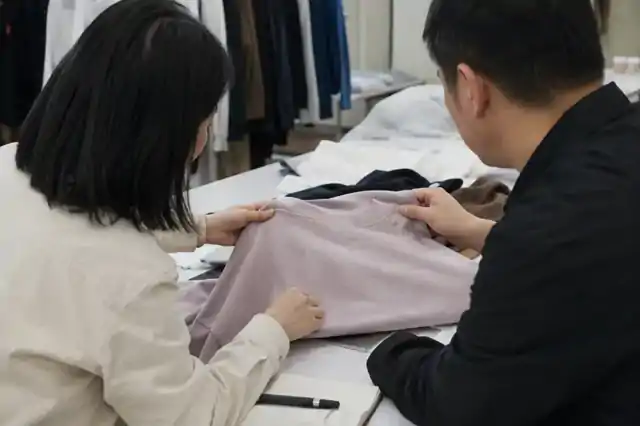
What to request in a live workshop conversation
A live conversation can connect a photograph to a current discussion, but it is not independent certification. Respect filming restrictions and worker privacy. If an operation is external, ask for its responsibility and approval path rather than assuming that subcontracting by itself proves a problem.
- The production location and the person responsible for your project.
- A relevant garment or construction example, not only a general showroom.
- The proposed operations and any partner processes for your specific style.
- How approved materials, artwork and sample versions will be identified.
- How inspection findings and requested changes reach the person who can approve them.
Why a good sample is a starting point
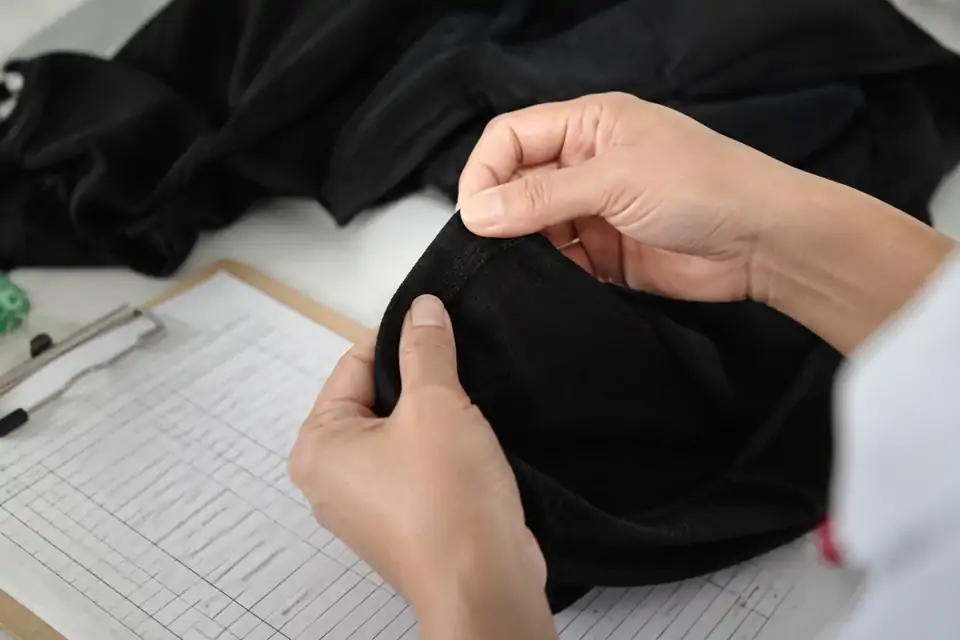
A sample demonstrates one result. For bulk, confirm which sample and files are the standard, whether the proposed materials are final, and which checks will be made before release. Record how substitutions or specification changes require approval.
SGS describes final random inspection as checking selected goods against reference and order requirements. That scope is different from certifying every garment or guaranteeing future production. If independent inspection is needed, agree the provider, timing, sampling scope and response to findings before the goods are ready.
References, reports and photographs: check the scope
For a report, match the company, product or material, date, test or inspection scope and result to the claim being made. A document for another fabric, site or period may not answer your question. Ask for clarification where the link is missing rather than displaying the document as a general seal of quality.
For references, request permission before contacting another buyer and focus on comparable products and order conditions. For photographs, ask what is shown and when it was taken. Do not interpret visible machinery as a verified capacity figure or proof that every process is in-house.
Finish with a controlled decision, not a league table
Shortlist the suppliers whose evidence fits your garment, development needs and commercial constraints. Record the reason for choosing the next sample or order stage, the unresolved items and the approval owner. Recheck changed materials, prices and responsibilities on a repeat order.
This guide intentionally does not name a “best factory.” Suitability depends on the brief, and the evidence changes over time. The stronger outcome is a traceable choice that another member of your team can understand and review.
Put this guide to work
Use workshop evidence to ask better questions
Start with the factory photographs, then ask to connect the visible operations to your proposed product. Request the contracting company details, production location and responsibility for any partner operations. Review a relevant physical sample and agree the records needed for your order. A convincing image or a completed checklist is not independent certification. Keep evidence dates and unresolved questions visible instead of converting impressions into an unsupported score.
Your decision checklist
- Match the company on the quote to the agreed production scope.
- Ask for evidence relevant to your garment and required checks.
- Record what has been verified and what remains unconfirmed.
These are planning examples, not customer case studies or quotations.
Frequently asked questions
Is Alibaba or Instagram proof of legitimacy?
No. They are discovery channels. Verify the legal entity, operational capability, samples, terms and relevant references independently.
Do I need a third-party audit?
It depends on order value and risk. A third-party social, capability or quality audit can add evidence but does not replace product inspection.
What is the best first order size?
The quantity should be commercially survivable for the buyer and operationally stable for the chosen production route. There is no universal number.
Sources and evidence notes
Community sources document recurring buyer questions and experience; they are not treated as universal technical standards. Official guidance is identified separately.
- Community discussionReddit: questions from a new apparel founder
- Community discussionReddit: contacting around 50 manufacturers
- Inspection provider: service scopeSGS: final random inspection against agreed specifications
- Official US guidanceFTC: US textile and wool labeling requirements