Quick answer
For many men’s performance tees, 180–210 g/m² is a versatile lightweight starting band, while 220–250 g/m² can add coverage and structure. The number is not a quality score. Compare equivalent composition and construction, then approve opacity, drape, drying and decoration on the actual sample.
The question behind this guide
Is 180, 200, 220 or 250 GSM best for a performance tee?
Founder and sourcing discussions repeatedly return to buyers comparing GSM as a quality grade rather than fabric mass per area. These posts are used to identify buyer uncertainty, not to establish a technical rule or market statistic.
Read the community discussionThis guide separates community question signals from standards, government guidance and order-specific factory decisions. Rankings are conditional decision aids, not universal product scores or claims that SenLin holds a named certification.
Key takeaways
- GSM measures fabric mass per area.
- More mass can add coverage but also heat and drying time.
- Specify a finished-fabric tolerance.
- Approve garment weight and feel across the size range.
Weight bands by product objective
These are sampling bands, not guaranteed performance categories; fiber, knit and finish can move the outcome.
Read the table as a shortlist for discussion. The final decision should be recorded against the intended wearer, garment construction, destination market, approved sample and commercial quantity.
| Rank | Band | Likely direction | Main check |
|---|---|---|---|
| 1 | 190–210 g/m² | Versatile training tee | Opacity and drying |
| 2 | 210–230 g/m² | More structured premium tee | Heat and drape |
| 3 | 180–190 g/m² | Lightweight warm-weather layer | Transparency and snagging |
| 4 | 230–250 g/m² | Dense crossover tee | Movement and drying |
What buyers often misunderstand about performance-tee GSM
Finished garment weight is not the same as fabric GSM. Pattern area, size, trims and seam construction change the total garment mass.
A single headline value cannot describe the whole garment. Composition, knit or weave, finishing, pattern geometry, seams, decoration and care conditions interact. Ask which variable changed, what stayed constant and which sample or report supports the answer.
What to put in the development brief
Write requirements as testable decisions rather than adjectives such as premium, breathable or durable. If the target is unknown, label it as an open development question and agree how the sample will be compared.
For a custom sportswear factory enquiry, connect performance-tee GSM to the style code, colour, size range, logo route and order quantity. This keeps the answer usable when the project moves from quotation to sampling and bulk.
- Finished GSM target and tolerance.
- Composition, knit and finish.
- Color-specific opacity.
- Garment size and silhouette.
- Decoration dimensions and process.
Sample and evidence plan
Verify whether the stated GSM applies to finished, conditioned fabric. Compare a cut garment because drape and opacity change when fabric is placed over the body.
Keep the physical sample identifier, specification revision, material reference, artwork file and approval comments together. A report for another material or a successful prototype does not automatically prove that later bulk goods are identical.
- Confirm the question and acceptance criteria before testing.
- Use the proposed bulk material and construction where practical.
- Record method, conditions, result, date and sample identity.
- Resolve failures or substitutions before bulk release.
Factory confirmation checklist
SenLin’s published order baselines remain standard styles at 100+ pieces and custom developments at 300–500+ pieces; the applicable allocation, material route and decoration minimum must still be confirmed in the quotation. Published baselines are not an automatic acceptance of every specification.
| Checkpoint | Question to ask | Record to retain |
|---|---|---|
| Mass | Is the value finished fabric mass per area? | Fabric specification |
| Tolerance | What variation is acceptable? | Signed tolerance |
| Garment | How does it behave on the fit model? | Approved sample |
Decision and risk note
Pick the lightest fabric that still meets coverage, durability and brand handfeel. Extra mass should solve a defined problem.
Regulations and buyer requirements vary by product and destination. Use qualified compliance advice where needed, and do not print a performance, fiber, sustainability or care claim until the responsible party has a reasonable basis for it.
Continue your buyer research
Connect this decision to the relevant product, factory process and frequently asked questions before requesting a quotation.
Frequently asked questions
Is 250 GSM too heavy for gym wear?
It may suit a structured style but can feel warm; sample for the target climate.
Does dark fabric need the same weight as white?
Opacity can vary by color, so confirm each important colorway.
How is GSM measured?
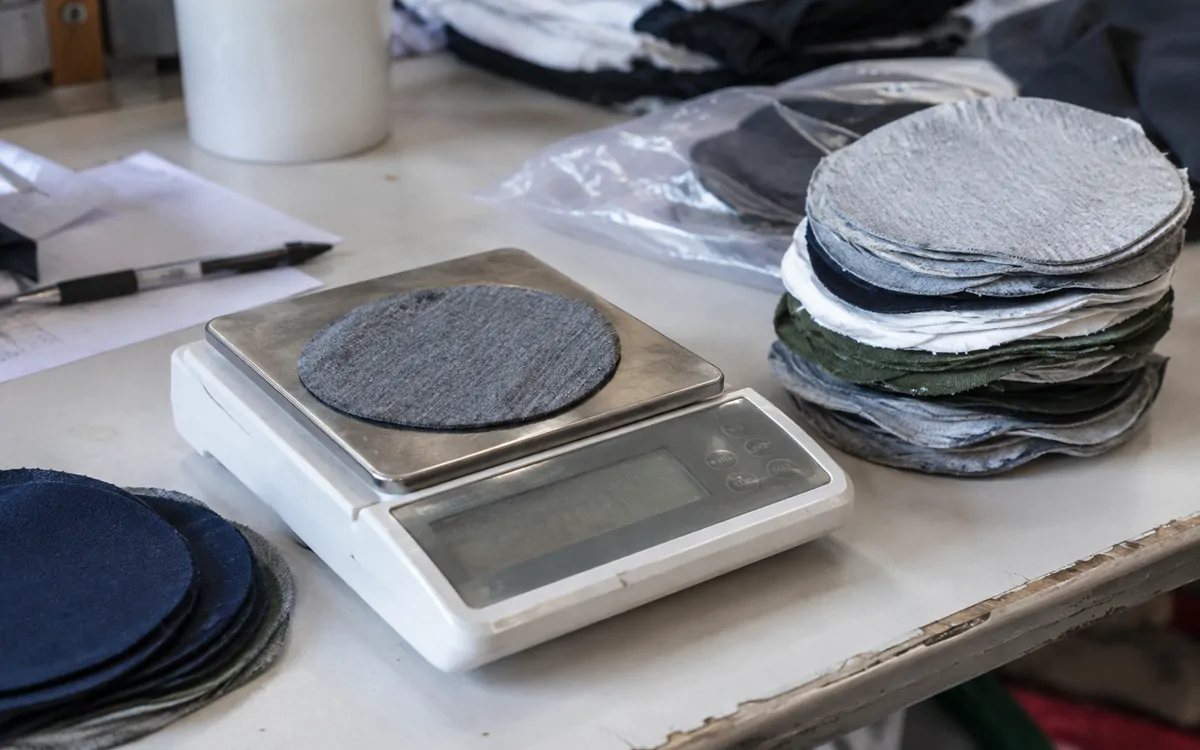
Use an agreed recognized fabric-mass method rather than estimating from garment weight.
Sources and evidence notes
Community sources document recurring buyer questions and experience; they are not treated as universal technical standards. Official guidance is identified separately.
- Community discussionReddit: activewear factory, fabric and lead-time questions
- Community discussionReddit: small-brand manufacturing workflow
- Standards publisher: public scopeASTM D3776: mass per unit area of fabric
- Standards publisher: public scopeISO 6330: domestic washing and drying procedures